HPI: Pelham Historic District

Community Conversations: Historic Designation in Pelham
Please vote on whether WMAN should support the nomination of the Pelham neighborhood to become a locally and nationally designated historic district. Voting is open until May 15th.
Vote here!
Slides and Notes from Community Meetings:
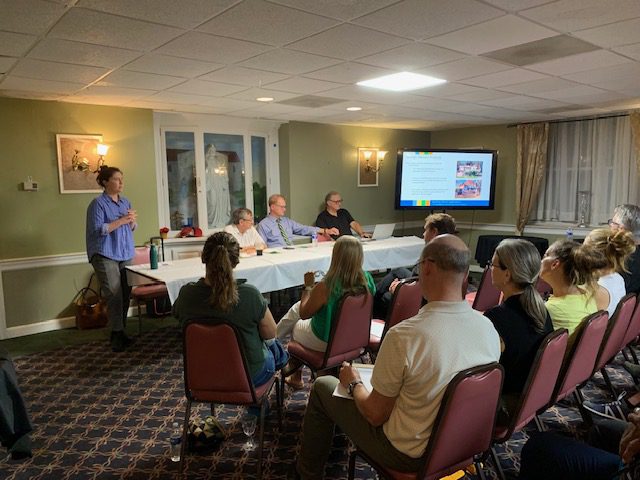
May 29th, 2025 | Slides | Notes
July 31st, 2025 | Slides | Notes
September 25th, 2025 | Slides | Notes
November 6th, 2025 | Slides | Small groups discussions, no notes
March 26th, 2026 | No slides | Notes
Questions from the Community
The following questions have been gathered directly from the Pelham community over the course of multiple meetings. For additional information, please see the Philadelphia Historical Commission website.
Definitions:
Philadelphia Historical Commission (PHC, or the Commission) – A group of appointed commissioners that maintains the Philadelphia Register of Historic Places, reviews nominations for new historic designations, and reviews building permits for existing designations. It also offers technical assistance and guidance to the public with all services free of charge.
Regulation, Enforcement, and Changes to a Building
Is there a list of things that are regulated?
- There isn’t a set list since this varies per house and designation. What triggers the review by the Philadelphia Historical Commission is pulling a permit, so any exterior work that requires a permit will be automatically reviewed. Some changes that do not require a permit are also regulated, like repointing. Slides 11 and 13 here contain more examples about what the Commission does and does not regulate.
We have a wide range of income levels in Pelham. How are varying income levels taken into account if repairs are needed?
- The Commission works with the property owners, and the solution will be different for every property and every situation. There is flexibility in the materials that can be approved for a given repair or project, and the Commission tries to have a variety of materials at different price points as options. A few examples: a slate roof may often be replaced with something other than slate; vinyl replacement windows may be approved for areas that are not visible from the public right of way; aluminum clad wood can be approved, and the Commission is looking into acceptable fiberglass windows.
- Philadelphia does not currently have financial assistance specific to historically designated properties, but there are a variety of programs available for home repair
- URDC (Urban Resources Development Corporation)
- PHDC, which offers several programs like Basic Systems Repair Program, Adaptive Modifications Program (AMP), and more
- Additional city programs, including the Senior Housing Assistance Repair Program
There is discussion of “all renovations” will be more expensive if PHC gets involved as designation is achieved. Examples cited include roofing, windows, custom doors, masonry repair, etc.
- There may be some cases where this is true, but certainly it is more nuanced than “everything will be more expensive”. For most projects that will have to adhere to higher standards, it is worth looking to see if there are equally acceptable approaches that do not require significant expenditures:
- Roof areas – if roof replacement becomes necessary, only those areas that are visible from the street will be required to match the type of roof that is currently on the house. There is always a concern when the original roof is slate. We understand that the Commission has been working hard to help mitigate cost concerns and that roof products that simulate the look of slate and are significantly less expensive are acceptable in most cases. In our experts’ experience, only in the most extreme cases would the commission insist on a slate replacement for the visible portion of the roof.
- Windows – for windows that are regulated (the ones that are visible from the street), our experts find that there are many affordable solutions working with savvy contractors who can provide restoration of existing sashes and frames. If desired, energy efficiency can often be accomplished with interior storm window panels. This example is simple stewardship and can be more affordable than replacing with newer windows. Please note that if your house has original windows, they have lasted for 120 years or so. The lifespan of modern windows might only be 20-30 years.
- Custom Doors – doors that are currently produced to match historical materials and style can be very expensive, but restoring an existing door or even working with a contractor to locate a salvaged door are simple ways to alleviate the need for a new door.
- Masonry repair – parts of your house visible from the street will need to go through more scrutiny. This might involve hiring a masonry contractor that has experience with historic structures. As most professionals will relate to you, if an inexperienced contractor who does not understand the needs of a century old masonry wall is used, the use of the wrong kind of mortar that is easily available in most home centers can actually accelerate the destruction of your wall. Yes, it may be slightly more expensive, but not as expensive as needing to correct the work of an inexperienced worker that has no historic oversight.
Will the designation process restrict me from doing whatever I want to my house? Examples (beyond solar panels addressed below) were being able to place a metal stove pipe out the wall of your house.
- Yes, there may be limits to what you can do to the areas that are visible from the street, but if you choose to put a stovepipe out of the back of your house, there will be no issues. Pipes, fans, vents, and other small exterior appurtenances are frequently allowed when they are carefully placed and unobtrusive.
A lot of houses have been modified over time. If you have to make repairs, what “version” of the house do you need to match?
- While designation does not require any inherent restoration, if an owner is making a change to an element that is regulated then the options will be based on what is outlined as the historic time period in the designation.
What is the duration of the permitting/review process?
- If you are submitting a building permit, the application is submitted to L&I and you don’t have to submit anything additional for the Historical Commission review because it will automatically get forwarded to the Commission as part of its review process. Always refer to the City of Philadelphia Historical Commission for the most up-to-date information on the review process. Historically, the Historical Commission has had 5 days to review relevant projects after receipt of the Department of Licenses & Inspections (L&I) as part of their overall 15-day review process. In the event of an emergency such as a tree falling on to a historic building, property owners may contact the Historical Commission directly for guidance.
What if a resident doesn’t file for a building permit like they should? What if a developer does whatever they want anyway?
- L&I does the enforcement. If the Philadelphia Historical Commission learns or sees that something has been done incorrectly, then L&I is asked to send a violation. There will be a fine, and the issue must be fixed. Eventually there could be a court summons.
- Violations can be reported via 311, but there is no expectation or obligation from the general public to do so.
Socio-economic Impact
Does historic designation cause gentrification?
- This is a common myth, but PlaceEconomics has extensive, recent research that shows otherwise. For example, five existing historic districts have a median household income below Philadelphia’s citywide median of $60,698 (source). This includes the Diamond Street Historic District, the city’s first historic district designated in 1986, which is not gentrified. Conversely, there are old historic neighborhoods in West Philly that are not designated, that have been very gentrified.
- Historic districts contain a greater diversity of housing types and price points than non-historic districts.
Historic Districts and the Pelham Boundaries
Is it a geographical area that gets designated, or individual buildings?
- It’s a geographical area with a shared history, and every single building gets marked as significant (these are usually ones that are or could be individually designated), contributing, or non-contributing. Non-contributing buildings are less regulated, and the impact to the district is considered rather than the impact to the specific property.
What are the Pelham boundaries for the proposed Historic District?
- The initial boundary for consideration is the 1907 map depicting the Pelham development. Over the past 40 years, fellow neighbors and historians, led by the work of former Pelham resident Lois Frischling, have refined that boundary to center on the length of Pelham Road and extending on either side to Carpenter Lane and Hortter Street. Historic research will determine the final boundary.
- See the original 1907 Wendell & Smith map of Pelham with the preliminary boundary in red here.
Timelines and the Nomination Process
What is the timeline of the potential Pelham Historic District designation?
- A set timeline is not fully known at this time. WMAN has been engaging with the community since May 2025, and will continue to do so. If it is decided to proceed with a nomination, the rest of the steps could take a year or more, but it can vary a lot from nomination to nomination. To prepare a nomination, research and photographs of every property are required along with a boundary description and a detailed essay of historic significance (this is typically done by a consultant). All of this has to be reviewed, and then there is a formal approval process (open to the public). The community involvement that WMAN is partaking in is independent of the official nomination process.
- WMAN has received a Keystone Historic Preservation Grant, which “supports projects that identify, preserve, promote and protect historic and archaeological resources of Pennsylvania for both the benefit of the public and the revitalization of communities”. The deadline to complete the nomination materials to receive the benefits from this grant is September 2026.
Can property owners build or demolish while the process is going on?
- Once the nomination is submitted, then a notice is mailed out to all the property owners. At this point, the same regulations are in place as if the district were designated. However, this only goes into effect when the nomination is submitted – not while research is conducted or while the nomination is being prepared.
Miscellaneous Questions
Can you install solar panels?
- The Historical Commission frequently receives applications to install solar panels on historically designated structures. The Historical Commission works with property owners to configure the solar panels in a way that minimizes the impact to the historic structure. Recent examples include solar panel installation in Overbrook Farms Historic District, built by the same developer as the Pelham community.
What happens to water/electric/gas costs and payment process?
- Nothing, there is no impact to utility costs, and no change to your current process of paying utilities.
How does new construction or a new addition work with the design review for a historic neighborhood?
- When a district is nominated, there is an inventory taken. If a building existed at the time of the designation, and it is demolished (either due to disrepair or as a non-contributing building), then PHC has full jurisdiction over the new design. However, for new construction on an empty lot or a parking lot, PHC only has review and comment power on the designs.
- Additions are reviewed all the time, and many go through a quick review process. They are generally looking for something that is “differentiated but still compatible with the historic resource”.
Additional Resources
Philadelphia Historical Commission
Preservation Alliance for Greater Philadelphia
Philadelphia Register of Historic Places
National Register of Historic Places
What is Historic Preservation and Why Does it Matter?
Growing through Preservation: The Economic Impact of Historic Preservation in Philadelphia (2025)